Reviewing Rubrics and Tests Used to Train AI Models
Posted
Reviewed the rubrics and automated tests used to grade AI training data, checking each criterion had exactly one defensible interpretation and separating checks a machine can verify from those needing human judgment.
Project details
Reviewed the rubrics and automated tests used to grade AI training data, checking that each grading criterion had exactly one defensible interpretation — if it admits two readings, it measures whether the model guessed the author's intent rather than whether it was correct.
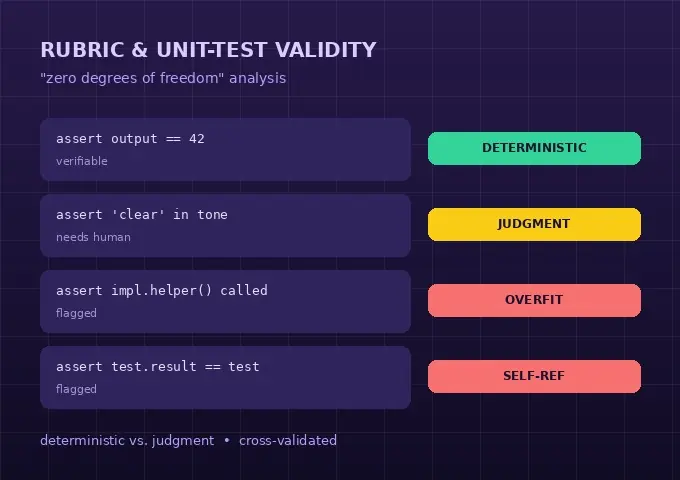
Flagged three recurring failure patterns: tests that only pass for one specific solution and fail correct alternatives; tests that check their own output rather than the behaviour, so they pass regardless of correctness; and criteria weighted wrongly, teaching the model the wrong lesson even when the check itself is sound.
Separated criteria a machine can verify automatically from those needing human judgment — the distinction that decides whether an item can be scored automatically at all.
Read the Python test suites directly rather than working from task descriptions, since the test is the real specification, and checked for requirements the tests never exercised.
Cross-checked conclusions against independent analysis, treating disagreement between the two as a signal to look harder rather than accepting either as authoritative.
The analytical core is the same one used for academic records at FUTA: establish ground truth, verify against it, and document the reasoning so someone else can check the conclusion.
Work Context: Delivered as AI Training Data Scientist / Data Analyst for Outlier (Remote, North York, ON, December 2025 – July 2026).
Impact
Case study
Project Summary
Evaluated the validity of rubrics and unit tests used to train AI agents, applying a "zero degrees of freedom" standard to surface overfit assertions, self-referential test logic, and reward/penalty scoring errors, and separating machine-verifiable criteria from natural-language judgment.
Work Context
Delivered as AI Training Data Scientist / Data Analyst for Outlier (Remote, North York, ON, December 2025 – July 2026).
The Problem
Training data for AI agents is often graded by rubrics and unit tests written alongside the task. If a grading criterion admits more than one defensible interpretation, it does not measure capability — it measures whether the model guessed the author's intent. Worse failure modes hide inside tests that look rigorous:
- Overfit assertions that pin behaviour to one specific implementation, so a correct alternative solution fails.
- Self-referential test logic that validates its own output rather than the behaviour under test, and therefore passes regardless of correctness.
- Reward/penalty scoring errors that misprice a criterion, teaching the model the wrong lesson even when the check itself is sound.
Approach
- Applied a "zero degrees of freedom" standard: a criterion is valid only if it has exactly one defensible interpretation. Anything else is a judgment call wearing a checkmark.
- Classified every criterion as either deterministic and programmatically verifiable or requiring natural-language judgment — the distinction that decides whether an item can be machine-scored at all.
- Read the Python/pytest suites directly rather than reasoning from task descriptions, since the assertion is the real specification.
- Cross-validated conclusions against independent AI-generated analysis, treating disagreement between the two as a signal for where to look harder rather than accepting either as authoritative.
- Applied coverage-gap analysis to find requirements the tests never exercised.
Results and Impact
- Validity standard applied: zero degrees of freedom per criterion
- Criterion classification: deterministic vs. natural-language judgment, made explicit in every report
- Verification method: two-way cross-validation against independent analysis
- Findings delivered as structured written analysis supporting dataset-integrity decisions
Deliverables
- Structured written analysis reports per task set
- Criterion-level classification separating verifiable checks from judgment calls
- Identified failure modes: overfit assertions, self-referential logic, scoring errors
- Coverage-gap findings for untested requirements
Technical Notes
- Tools: Python, pytest, rubric and test-design review, LLM evaluation methodology.
- The analytical core here is the same one used for academic records at FUTA: establish ground truth, verify against it, and document the reasoning so the conclusion can be checked by someone else.
- A test that cannot fail is worse than no test — it produces false confidence and consumes the grading budget that a real check would have used.