127-Chapter Role-Based User Documentation
Posted
Wrote and maintained 127+ chapters of user documentation for a coaching platform, tailored so each type of user reads only what applies to them, with automated checks that catch broken links before release.
Project details
Wrote 127+ chapters of user documentation covering four types of platform user — administrators, staff coaches, independent coaches, and two client types — so each audience reads only what applies to their role.
A single undifferentiated manual would have made things worse: a staff coach reading administrator procedures learns steps they cannot perform and misses the ones they can.
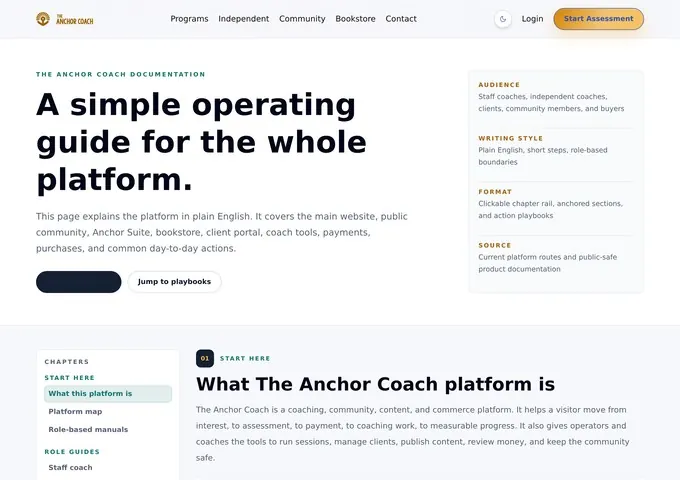
Wrote in plain English with short steps and clear role boundaries, plus action playbooks answering 'how do I do this' rather than only 'what is this'.
Added automated link checking so a renamed or removed chapter breaks the build on the change that caused it, instead of leaving dead links for users to find.
Built public documentation pages alongside the internal role-scoped material, keeping one body of content serving both audiences.
This extends the documentation-standards practice established across admissions and examination workflows at FUTA, where written procedure was what made a one-person office auditable.
Work Context: Delivered as IT Application/Production Support Analyst for Anchor Coaching (Remote, North York, ON, September 2025 – September 2026).
Live reference: Live surface: platform documentation — https://www.theanchorcoach.com/documentation
Impact
Case study
Project Summary
Wrote and maintained 127+ chapters of user documentation for a coaching platform, organised so each type of user reads only what applies to them, with automated checks that catch broken links before release.
Work Context
Delivered as IT Application/Production Support Analyst for Anchor Coaching (Remote, North York, ON, September 2025 – September 2026). The public documentation surface is live at https://www.theanchorcoach.com/documentation.
The Problem
A platform with four distinct user types — Super Admin, Staff Coach, Independent Coach, and two client types — cannot be documented as one undifferentiated manual. A Staff Coach reading Super Admin procedures learns things they cannot act on and misses the ones they can. Meanwhile, documentation that is not validated rots silently: a renamed route leaves dead links that nobody notices until a user hits one.
Approach
- Structured the material as role-based manuals so each audience reads only the surface it actually operates, with a clickable chapter rail and anchored sections for navigation.
- Wrote in plain English with short steps and explicit role boundaries, rather than in feature-reference style.
- Added action playbooks for common day-to-day tasks, so the docs answer "how do I do this" and not only "what is this."
- Wired link integrity checking into CI, so a renamed or removed chapter breaks the build on the pull request that caused it.
- Sourced content from current platform routes and public-safe product documentation, keeping it anchored to what the software actually does.
Results and Impact
- Chapters authored: 127+
- Distinct roles covered: four user types, plus public documentation surfaces
- Cross-link verification: automated, run on every pull request
- Dead links reaching production: caught at CI rather than reported by users
Deliverables
- Role-scoped manuals for Super Admin, Staff Coach, Independent Coach, and client types
- Public documentation surface with chapter rail and anchored sections
- Action playbooks for recurring operational tasks
- CI job validating cross-links and chapter references
- Deployment runbooks for production cutover procedures
Technical Notes
- Treating documentation as a build artifact — subject to the same validation gates as code — is what keeps it accurate past the week it was written.
- Role scoping is a security-adjacent concern as much as a usability one: documentation that describes actions a role cannot perform invites support tickets and confusion about permissions.
- This extends the documentation-standards practice established across admissions and examination workflows at FUTA, where written procedure was what made a one-person office auditable.