Portfolio Web Operations & Domain Administration
Posted · Updated
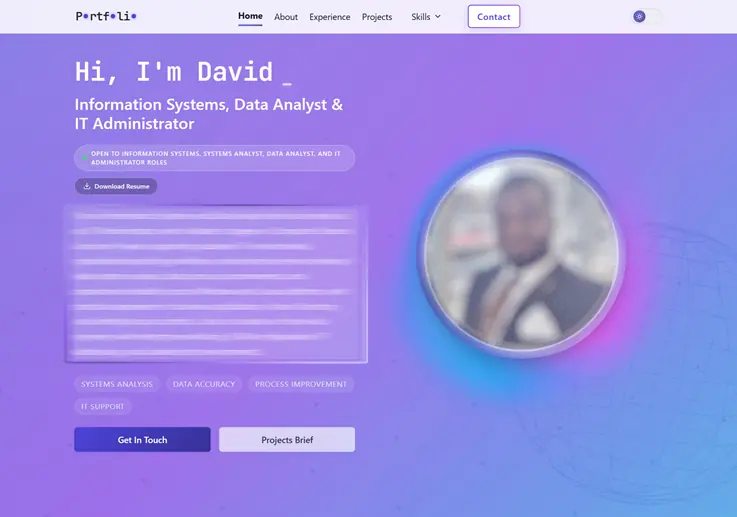
Built and operated my portfolio website as a production-style web and domain operations project — CMS-managed delivery, DNS administration, Microsoft 365 identity governance, scripted releases and pre-flight validation — then applied the same practice at production scale by shipping DNS-verified custom storefront domains and fixing outbound SMTP delivery for a multi-tenant coaching platform.
Project details
Designed and maintained a CMS-managed portfolio platform using Decap CMS with structured JSON data sources, responsive Tailwind CSS layouts, and modular JavaScript rendering, enabling section-level content updates without manual HTML edits across homepage and project views.
Managed end-to-end domain operations for davidoncloud.com, including A/CNAME/MX/TXT record lifecycle updates, routing validation before and after each change window, SSL certificate continuity checks, and hosting provider alignment to maintain stable public availability and email delivery.
Extended the same domain-operations practice to production multi-tenancy at Anchor Coaching (Remote, North York, ON, September 2025 – September 2026): shipped host-resolved, DNS-verified custom storefront domains so independent coaches can attach their own domain with ownership proven through DNS records, gated behind an explicit environment-variable feature switch and documented in a go-live runbook.
Restored outbound mail delivery on the platform's Hetzner hosting by moving SMTP from port 465 to 587 with STARTTLS after a provider port policy blocked the original path, then added send rate limiting, audit logging, and mailbox access revocation on coach offboarding.
Integrated Microsoft 365 Admin Center workflows with domain-backed identity and service administration, covering user provisioning, license assignment, role-based access changes, mailbox configuration, and access troubleshooting for day-to-day operations support.
Implemented a scripted release workflow using Bash automation that handles version bumping, cache-busting updates across HTML assets, changelog generation, Git tagging, and remote push in a single repeatable pass, reducing manual release steps and preventing version drift.
Standardized deployment validation with a Node.js-based pre-flight check script that verifies HTML structure, CSS feature usage, JavaScript syntax, image asset integrity, favicon presence, and version consistency before each release, catching configuration issues before they reach production.
Containerized recurring support utilities and validation checks with Docker to keep troubleshooting scripts, environment tests, and deployment verifications portable and consistent across local development and production environments.
Localized all runtime frontend dependencies (Tailwind CDN, AOS, Three.js, Vanta, Feather Icons, Decap CMS) and font assets to the repository to eliminate external CDN calls, improving page load reliability, offline development capability, and production resilience.
Work Context: At FUTA (Systems & Data Analyst / System Programmer, 2017–2023), I managed implementation handovers, post-deployment stabilization, and operational continuity for high-visibility institutional systems. At Pures College (IT Systems Support and Computer Instructor, 2024–2025), I maintained lab software installations and configuration baselines across classroom environments.
Current Implementation: I now apply the same release discipline, validation controls, and operational monitoring to my portfolio operations, combining CMS governance, domain administration, identity controls, and continuous service validation.
Source: this site's full source is public at https://github.com/toughdave/david-on-cloud
Impact
Case study
Project Summary
Built and operated my portfolio website as a production-style web and domain operations project, combining CMS-managed content delivery, DNS record administration, Microsoft 365 identity governance, scripted release automation, and pre-flight validation checks across 50+ versioned releases.
Work Context
At FUTA (Systems & Data Analyst / System Programmer, 2017–2023), I managed implementation handovers, post-deployment stabilization, and operational continuity for high-visibility institutional systems. At Pures College (IT Systems Support and Computer Instructor, 2024–2025), I maintained lab software installations and configuration baselines across classroom environments. Those same controls shaped how I run this website project end to end.
Current Implementation
I now apply the same release discipline, validation controls, and operational monitoring to my portfolio operations, combining CMS governance, domain administration, identity controls, Docker-containerized support utilities, and continuous service validation before each production update.
Extension: Multi-Tenant Custom Domains at Anchor Coaching
The same domain-operations skill set was applied at production scale during my contract engagement with Anchor Coaching (Remote, North York, ON, September 2025 – September 2026), where the requirement moved from operating one domain to letting many coaches attach their own.
- Shipped host-resolved, DNS-verified custom storefront domains, so an independent coach can point their own domain at their storefront and have ownership verified through DNS records before the domain goes live.
- Gated the capability behind an explicit environment-variable feature switch, so the rollout could be enabled deliberately per environment rather than shipping on by default.
- Authored a deployment runbook for custom-domain go-live, covering the ordered steps and verification points for the production cutover.
- Diagnosed and resolved outbound mail delivery on the platform's Hetzner hosting, moving SMTP from port 465 to 587 with STARTTLS after the provider's port policy blocked the original configuration — the same class of connectivity troubleshooting as a blocked firewall port, applied to a mail path.
- Added rate limiting and audit logging to outbound mailbox sends, and access revocation on coach offboarding, so mail identity followed the same lifecycle discipline as any other account.
Results and Impact
- Production domain managed: 1 (
davidoncloud.com— DNS, SSL, email, hosting) - Multi-tenant custom domains: host-resolved and DNS-verified, feature-switched for controlled rollout
- Releases shipped: 50+ (versioned, tagged, and validated)
- Core service layers: 5 (web delivery, DNS routing, identity administration, CMS, CI/CD)
- Pre-flight checks: 9 automated validation gates per release
- Mail delivery: outbound SMTP restored on Hetzner via STARTTLS on 587, with send rate limits and audit trail
Deliverables
- CMS-managed content model using Decap CMS with structured JSON data sources
- Domain and DNS operations checklist covering A/CNAME/MX/TXT record lifecycle
- Scripted release workflow (Bash) handling version bump, cache-bust, changelog, Git tag, and push
- Node.js pre-flight validation script checking HTML, CSS, JS, images, favicon, and version consistency
- Docker-containerized support utilities for portable troubleshooting and deployment verification
- Localized frontend dependencies eliminating external CDN calls for production resilience
- Microsoft 365 Admin Center integration for identity provisioning and access governance
Technical Notes
- Website content is managed from JSON/CMS sources with modular JavaScript rendering.
- Domain and DNS changes are verified before and after each release window.
- Identity and access updates are handled through Microsoft 365 admin workflows.
- All runtime frontend dependencies and fonts are localized to the repository.
- Release automation reduces manual steps and prevents version drift across assets.
- Docker containers keep validation and troubleshooting tools consistent across environments.